日本語
SUMMIT_JP_2026 / BUILDER'S FAIR · HALL7 BF-01 ── SYSTEM DOSSIER

The Tidy-Up Ghost

Let Physical AI handle the tedious chores! — A home tidy-up robot / System overview document

Exhibit / Hall7 BF-01 Configuration / Edge-to-Cloud Physical AI As of / June 2026
SCROLL TO READ
PRE

AI Has Stepped Into the Physical WorldIntroduction ── What this demo points to

People often say "the era of Physical AI has arrived." For Amazon, that is not a prophecy about the future but an everyday reality.

We operate more than one million robots in warehouses around the world, and we run a foundation model (DeepFleet) that coordinates the entire fleet — all at the scale of our own operations. We are a company that confronts the difficulty of "running the physical world with AI" every day, and solves it every day. What we built through that implementation and operation is now open in the form of AWS.

Compressing months of training into a few hours with GPU simulation, transferring the trained brain to real hardware (Sim2Real), running it on the edge with low latency, and operating many units together — you can assemble the entire long journey of Physical AI, end to end, on a single foundation. That is what it means to choose AWS.

About this document

The Tidy-Up Ghost ("Shimatte-AI") is a demo that shows that end-to-end story not as slides, but as a single unit working right in front of you. This document summarizes the full picture of its design. The next unit you put into motion can start from here, too. Please come talk to us. *shiver… shiver…*

§00

Executive SummaryWhat is this demo ── grasp it in 30 seconds

ABOUT

Official title: Let Physical AI handle the tedious chores! — A home tidy-up robot / English name: The Tidy-Up Ghost / Code name (JP): Shimatte-AI

Exhibit: AWS Summit Japan 2026 / Builder's Fair / Hall7 BF-01

When a visitor speaks into the microphone, the character "the Tidy-Up Ghost" responds, and the SO-101 robot arm inside a miniature house automatically puts away erasers and markers — an Edge-to-Cloud Physical AI demo.

  • A configuration that loosely couples cloud intelligence (conversational agent and VLM-based success/failure judgment) with edge real-time control (VLA inference on Jetson Thor) via AWS IoT Core (MQTT).
  • The robot's motion model is a VLA (Vision-Language-Action) model fine-tuned with imitation learning, built as an end-to-end robot-grade MLOps pipeline: teleoperated data collection → training on SageMaker → distribution to the edge via Systems Manager + S3.
  • Composed of the educational robot SO-101 (~¥40,000 (approx. US$270) street price) plus the inference edge computer NVIDIA Jetson AGX Thor developer kit (~US$3,499 (~¥500,000-range)). The arm itself is inexpensive, and the aim is to show that an enterprise-grade demo can be assembled using only AWS managed services.
§01

Concept and ScenarioTidying a messy house with just your voice

An experiential demo that solves the everyday problem of "tidying a messy house is hard — wouldn't it be nice if a robot did it for you" with Physical AI and an IoT-enabled robot.

  • An SO-101 arm is installed inside a miniature house (aluminum-frame enclosure), and the robot puts items away with nothing but the visitor's voice commands.
  • The robot does not run pre-programmed fixed motions; it moves with a VLA model that generates actions from camera images and language instructions (= demonstrating that "it moves because it was trained").
  • After acting, the robot itself evaluates the overhead camera image with a VLM, judges success/failure, and speaks (an autonomous closed loop).
§02

Overall System ArchitectureFour layers: cloud / edge / training / physical booth

It consists of four layers: cloud (real-time control), edge (Jetson Thor), training pipeline (offline), and the physical booth.

architecture_overview.mmd (integrated view including planned items)
flowchart TB subgraph BOOTH["Exhibit Booth (Hall7 BF-01)"] VISITOR["Visitor"] MIC["Microphone"] APP["App Screen
Display mounted behind enclosure"] THORDISP["Thor Screen
Brought-in PC monitor, camera feed always on"] SLIDE["Exhibit Info Screen
Display beside enclosure, HTML loop + QR"] subgraph CAGE["Miniature House Enclosure (aluminum frame 97x65x65cm)"] FA["SO-101 follower arm x2"] LA["SO-101 leader arm x1
For manual / teleoperation"] CAMTOP["Overhead camera x1
OBR-WEBCAM200"] CAMWRIST["Wrist camera x2
InnoMaker U20CAM-1080P"] LED["LED lighting x4
Ambient-light mitigation"] ITEMS["Items
Eraser, marker, dice, etc."] end end subgraph EDGE["Edge (NVIDIA Jetson AGX Thor)"] SR["Strands Robots
VLA inference runtime"] VLAM["VLA model
π0.5 / ACT / GR00T
(training/validation; live show uses ACT)"] GGC["AWS Systems Manager
Hybrid management + S3 fetch"] SR --> VLAM end subgraph CLOUD["AWS Cloud"] WEBHOST["CloudFront + S3
App/dashboard/docs delivery"] VOICEAGENT["Voice agent
Strands Agents + Bedrock"] POLLY["Qwen3-TTS (SageMaker inference EP)
Tidy-Up Ghost voice (voice clone)"] VLM["Bedrock VLM
Task success/failure from overhead image"] IOT["AWS IoT Core
MQTT broker"] end VISITOR -->|"Voice command"| MIC MIC -->|"Utterance"| APP APP <-->|"HTTPS"| WEBHOST APP -->|"Instruction text"| VOICEAGENT VOICEAGENT -->|"Response text"| POLLY POLLY -->|"Audio"| APP VOICEAGENT -->|"Publish action command"| IOT IOT <-->|"MQTT sub/pub"| SR SR -->|"USB control"| FA SR -->|"USB control"| LA CAMWRIST -->|"USB video"| SR CAMTOP -->|"USB video"| SR FA --> ITEMS CAMTOP -.->|"Overhead image (planned)"| VLM VLM -.->|"Success/failure (planned)"| VOICEAGENT LED -.->|"USB power, always-on illumination"| ITEMS VOICEAGENT -.->|"Cloud control of lighting is concept only (not implemented)"| LED THORDISP -.->|"Video display"| SR
How to read this diagram (important)

This diagram is an integrated view that includes the planned specification. The dotted (dashed) paths ── cloud control of lighting and VLM success/failure judgment of the overhead image ── are not implemented in the current repository code. For the implemented configuration (code-verified), see the "Implemented E2E architecture" diagram at the bottom of this section.

PointsKey design points

  • The cloud side is fully serverless/managed (Strands Agents, Bedrock, Polly, IoT Core, CloudFront, S3).
  • Cloud and edge are loosely coupled via IoT Core MQTT. The cloud agent publishes natural-language commands, and the edge Strands Robots subscribes continuously and triggers VLA inference.
  • VLA inference runs locally on the edge (Jetson Thor), so the arm can be controlled in real time without being affected by network latency.
  • PLANNED A concept in which success/failure judgment is done by the cloud VLM (Bedrock) using the overhead camera image. Intelligence in the cloud, instant response at the edge. *Not implemented in the current code.
  • CONCEPT ONLY Cloud ON/OFF control of the lighting was an early request, but the current code does not implement it. The LEDs are simply always on via USB power.

2.1Implemented E2E architecture (code-verified)

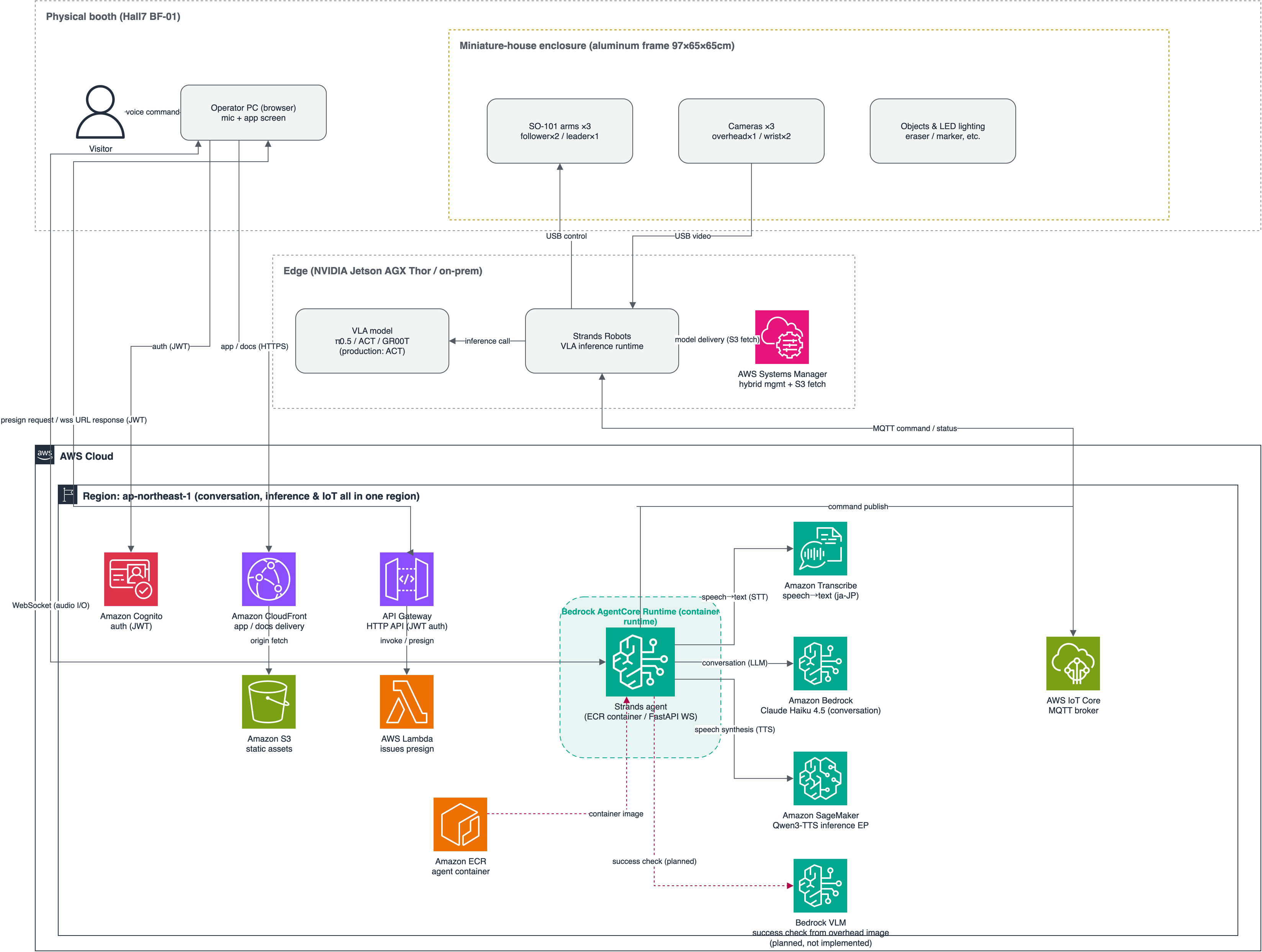
The diagram above is an integrated view including plans. The diagram below is the implemented E2E architecture, confirmed by close reading of the repository as the configuration actually implemented in code. Inference, conversation, and IoT control are all completed within the single ap-northeast-1 region (only the training system is in a separate region, see §06). The conversational agent runs as a Bedrock AgentCore Runtime (Strands Agents + FastAPI WebSocket running on an ECR container), calling Transcribe, Bedrock Claude, and SageMaker TTS, and publishing commands to the edge via IoT Core.

assets/aws-architecture-en.png (code-verified, implemented E2E)
The Tidy-Up Ghost inference-system AWS architecture, implemented version (single region ap-northeast-1). The Browser authenticates with a Cognito JWT, API Gateway→Lambda returns a presigned WebSocket URL, and the browser connects via wss to the Bedrock AgentCore Runtime (Strands Agents + FastAPI on an ECR container). The Runtime calls Transcribe (STT), Bedrock Claude Haiku (LLM), and SageMaker Qwen3-TTS (TTS), and publishes commands to IoT Core (MQTT). IoT Core (MQTT) links directly to the Jetson AGX Thor → Strands Robots → VLA (ACT and others) → SO-101 arm. Model delivery is via Systems Manager + S3 (Greengrass is a future option). VLM success/failure judgment is planned (dashed). CloudFront+S3 delivers the app.
§03

Tech Stack / AWS Services UsedCloud is fully managed, edge is Jetson

// tech stack
LayerElementRole / notes
Cloud: conversationStrands AgentsThe voice agent itself in the cloud. Orchestrates interpreting instructions, conversation, and issuing actions
Amazon BedrockThe agent's LLM. Conversational responses and action decisions
Amazon Bedrock (VLM)Looks at the overhead camera image after the action and judges task success/failure (closed loop) PLANNED
Qwen3-TTS (SageMaker inference EP)Speech synthesis (TTS). Generates the "Tidy-Up Ghost" character voice via voice cloning. Streaming inference. Amazon Polly (Kazuha) is the fallback when no endpoint is configured
Speech recognition (STT)Transcribes microphone input to text. = Amazon Transcribe Streaming
Cloud: communicationAWS IoT CoreMQTT broker. Cloud↔edge commands (shimatte/command) and status (shimatte/status)
Cloud: deliveryCloudFront + S3Static delivery of the app screen, training dashboard, and exhibit documents (HTML/PDF)
Cloud: trainingSageMaker AI (Training)Imitation-learning FT jobs for the VLA model (π0.5 / ACT / GR00T, etc.)
SageMaker MLflow AppsRecords training as Experiments. Also stores artifacts from real-hardware inference so they are traceable
GPU training instancesg6.2xlarge / g6e.2xlarge. Assumes roughly 6 hours of training for 20 episodes
AWS Systems ManagerRemotely accesses inside the Thor to perform tasks such as uploading data to S3
Cloud: simulationNVIDIA Isaac SimSim-based data collection environment. Looking ahead to Sim2Real
EdgeNVIDIA Jetson AGX ThorEdge inference machine. Runs the VLA locally (changed from Orin to Thor)
Strands RobotsA framework that handles VLA/robot control as a tool for Strands Agents (wraps lerobot)
AWS Systems ManagerManages the Jetson from the cloud via hybrid activation. Distributes models to the edge with send-command (the edge fetches from S3 with a presigned URL)
AWS IoT GreengrassFuture option for automatic model delivery (nucleus is co-located but not used for delivery)
VLA modelsThree VLAs trained in parallel and validated on real hardware. The live demo at the production booth uses ACT to execute three tasks (eraser, marker, dice). ① π0.5 (lerobot/pi05_base, based on PaliGemma 2B + Gemma 300M) = large, strong at generalization, the front-runner (3 tasks in validation); ② ACT = the predecessor of VLA (imitation learning without language instructions), lightweight, task-specialized (adopted for the live show = a single model integrating 3 tasks); ③ GR00T N1.5–N1.7 family (NVIDIA, validated on real hardware picking up a red pen). All trained on SageMaker. SmolVLA also validated
RobotSO-101 robot armFollowers x2 + leader x1. An inexpensive educational arm from the Hugging Face LeRobot family
Sensors/environmentOverhead camera x1 / wrist camera x2OBR-WEBCAM200 (overhead), InnoMaker U20CAM-1080P (wrist). Calibrated with ChArUco
LED lighting x4USB-powered, always on. Suppresses ambient light to stabilize VLA behavior. "Cloud ON/OFF control" is concept only and not implemented

Reference implementations / blogs

  • AWS Blog "Building intelligent Physical AI from edge to cloud with Strands Agents, Bedrock AgentCore, Claude 4.5, NVIDIA GR00T, and Hugging Face LeRobot"
  • Strands Labs blog (experimental agent development)
§04

Communication FlowFrom a single "put the eraser away" to the robot moving

The full sequence from a visitor saying "put the eraser away" to the robot moving and speaking the outcome.

realtime_control_sequence.mmd
sequenceDiagram autonumber actor V as Visitor participant APP as App Screen participant AG as Voice Agent participant TTS as Qwen3-TTS
(SageMaker inference EP) participant IOT as AWS IoT Core participant SR as Strands Robots(Thor) participant ARM as SO-101 follower participant CAM as Overhead camera participant VLM as Bedrock VLM V->>APP: "Put the eraser away" into the mic APP->>APP: Transcribe speech to text (STT) APP->>AG: Send instruction text AG->>AG: Interpret instruction, select task AG->>TTS: Response text (acknowledgment) TTS-->>APP: Synthesized voice (Tidy-Up Ghost) APP-->>V: "I'll give it a try~" AG->>IOT: Publish action command IOT->>SR: Deliver command (subscribe) SR->>SR: Feed image + instruction to VLA, infer loop Inference loop (seconds to tens of seconds) CAM-->>SR: Wrist/overhead camera video SR->>ARM: Joint-angle commands (USB) ARM-->>SR: Motion / state end SR->>IOT: Publish completion notice IOT->>AG: Completion notice AG->>CAM: Acquire overhead image CAM-->>VLM: Overhead image AG->>VLM: Request "did it succeed?" judgment VLM-->>AG: Success / failure alt Success AG->>TTS: Words of joy TTS-->>APP: Audio APP-->>V: "All tidied up~!" else Failure AG->>TTS: Apology + request for help TTS-->>APP: Audio APP-->>V: "Oops, I messed up… please help me" end

PointsCloud only at the round-trip junctions

  • The round trip: voice command → intent interpretation in the cloud → command to the edge via MQTT → VLA inference and arm control at the edge.
  • The VLA inference loop itself completes entirely within the edge (repeatedly acquiring camera video → outputting joint angles), so communication with the cloud occurs only at the "command" and "completion notice" junctions.
  • The VLM success/failure judgment after the action (bottom of the diagram) is planned and not implemented in the current code (see the §02 implemented diagram). What is implemented is "voice → Claude conversation → MQTT → edge"; the judgment loop is not yet connected.
Design insight: why "control = edge / success judgment = cloud"

This sequence mixes two kinds of inference with different characteristics. Not confusing them is a key point of Physical AI design.

Real-time control loopPost-action success judgment
ContentOutputs joint angles from camera video dozens of times per secondEvaluates "is it tidied up?" from an image just once
Latency requirementSevere Delays break controlLoose 1–2 seconds acceptable
PlacementAlways the edge (VLA on the Jetson)Can be in the cloud (Bedrock VLM)
  • Why the control loop is on the edge: it must close the camera→action loop at high frequency, and if cloud round-trip latency or a network outage gets in, control cannot hold. That is why VLA inference runs locally on the Jetson Thor (and this demo implements it).
  • Why success judgment can be in the cloud: it is a "one-shot" evaluation after the motion completes, with plenty of latency headroom. And open-vocabulary semantic judgment like "did the eraser land in the basket?" is better handled by a large VLM (Claude/Nova family); the VLA running on the edge (a model that outputs actions) is not suited to this purpose. Putting judgment in the cloud lets "look at the image → judge → speak" complete in the same place as the conversational agent (AgentCore + Claude Haiku). The image sent is a few tens of KB of JPEG, so communication cost is small too.
  • If you judged on the edge instead: you would need to load another judgment VLM, separate from the VLA, onto the Jetson, competing for the Thor's VRAM. The upside is network independence, low latency, and zero invocation cost. It is a trade-off.
  • General principle: Physical AI is conventionally divided by role into "fast reflexes = edge / smart thinking = cloud" (analogous to System1/System2 in VLA). For a detailed explanation, see Chapter 6 of the textbook edition.
§05

Visitor InteractionThree modes and three tasks ── a participatory experience design

Through the app screen, visitors move back and forth between the following modes while conversing with the "Tidy-Up Ghost." Conversation choices can be selected by speaking into the mic, with mouse operation available as a fallback.

interaction_modes.mmd
stateDiagram-v2 [*] --> ConversationMode ConversationMode --> VLAActionMode: Instruction like "put it away" ConversationMode --> ManualMode: Voice request "I want to move it myself" VLAActionMode --> SuccessJudgment: Motion complete SuccessJudgment --> ConversationMode: Success (joy) SuccessJudgment --> ManualMode: Failure (apologize, ask for help) ManualMode --> ConversationMode: Experience ends ConversationMode --> [*]

5.1The three modes

ModeContent
Conversation modeChat with the Tidy-Up Ghost. Choices are shown on screen, and the visitor selects by speaking into the mic (fallback: mouse)
VLA action modeBy voice command, the VLA autonomously controls the arm. After the motion, the overhead image is judged by the VLM; on success it rejoices, on failure it apologizes and asks for help
Manual modeActivated when the VLA fails, or when the visitor explicitly requests it by voice. The visitor grips the SO-101 leader arm at hand to directly operate the follower arm (a teleoperation experience)

5.2The three tasks the VLA performs

* Before each task, an exhibit staff member manually sets up the scene.

  1. Put the eraser in the basket (the most mature task; executable with just one arm, so it is the fallback for degraded operation)
  2. Stash the marker in the "S3 bucket" pen holder (a little pun on Amazon S3)
  3. Roll the dice toward a bowl, alternating left and right arms: before rolling, the visitor predicts even/odd, and after rolling, the VLM reads the pips and reports the result (a flourish to show off the VLM's recognition)
Important spec change

Originally "simultaneous two-arm (dual-arm) motion" was envisioned, but VLA actions were changed to single-arm inference only (dual-arm training was abandoned). The dice task uses left and right arms, but this is a staged alternating motion.

5.3Character production "the Tidy-Up Ghost"

  • Speech synthesis is a voice clone via Qwen3-TTS (SageMaker inference EP), giving it a distinctive character voice (with the verbal tic "~anyo" at the end of phrases, a *shiver… shiver…* kind of vibe).
  • Variations of success voices and failure voices are prepared to heighten the demo's experiential and entertainment value.
§06

VLA Training PipelineRobot-grade MLOps ── teleop collection → cloud FT → edge delivery

The heart of the demo is that "the robot moves because it was trained." It cycles through imitation-learning data collection by teleoperation → FT in the cloud → delivery to the edge. Sim2Real is also planned for integration.

Note: the learning method is imitation learning, not reinforcement learning. The Sim (Isaac Sim) is not a place for reward-driven trial and error; it is used for automatic generation of demonstration data, parallel collection, and pre-validation.

robot_mlops_pipeline.mmd
flowchart LR subgraph COLLECT["Data collection (real-hardware teleop)"] LEADER["SO-101 leader arm
Operated by a human"] FOLLOWER["SO-101 follower arm
Follows"] REC["lerobot record
Records video + joint angles"] LEADER --> FOLLOWER --> REC end subgraph SIM["Sim data collection (Isaac Sim)"] ISAAC["SO-101 in Isaac Sim
Cameras/gripper reproduced to match real hardware"] end subgraph TRAIN["Cloud training (AWS)"] S3DATA["Amazon S3
Episode data"] SMT["SageMaker Training
FT π0.5 / ACT / GR00T / g6.2xlarge"] MLF["SageMaker MLflow
Experiment records / artifacts"] S3MODEL["Amazon S3
Trained models"] S3DATA --> SMT --> MLF SMT --> S3MODEL end subgraph DEPLOY["Edge delivery & inference"] SSM["AWS Systems Manager
Hybrid management"] THOR["Jetson Thor
Inference with Strands Robots"] GG["IoT Greengrass
Auto delivery (future option)"] SSM -->|"send-command"| THOR end REC -->|"To S3 via SSM"| S3DATA ISAAC -->|"Sim2Real"| S3DATA S3MODEL -->|"Fetch model (S3 presigned)"| THOR S3MODEL -.->|"Future"| GG GG -.->|"Future"| THOR THOR -.->|"Trace real-hardware inference artifacts"| MLF

Implemented training pipeline (code-verified)

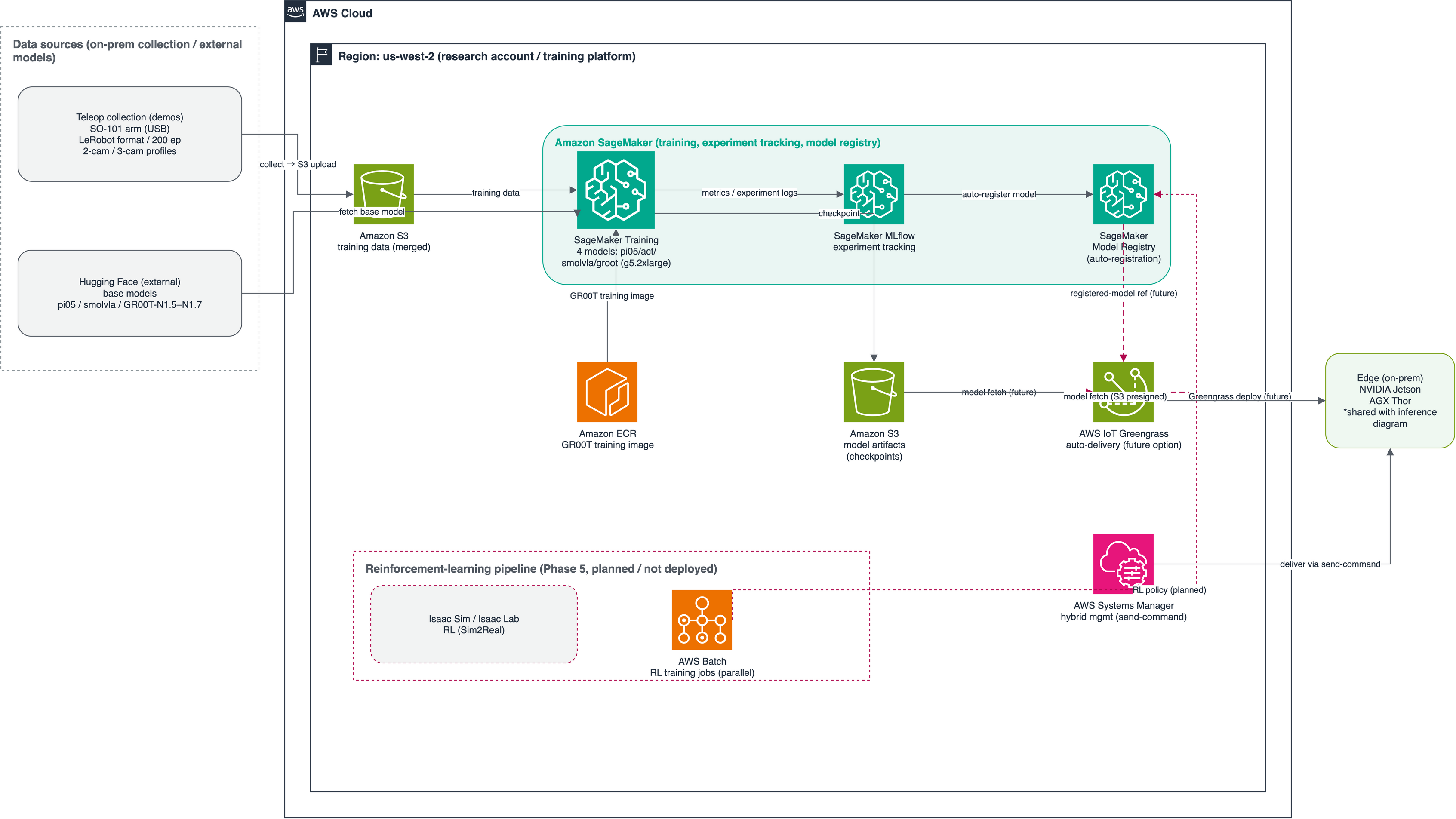
The diagram below is the implemented version, confirmed by close reading of the shimatte-ai-training repository. The training/research system all runs in us-west-2 (research account). SageMaker Training trains π0.5 / ACT / GR00T (N1.5–N1.7 family) / SmolVLA (ml.g5.2xlarge, with a custom ECR image only for GR00T), managed with SageMaker MLflow and Model Registry. Edge delivery of trained models via IoT Greengrass is a future configuration (not implemented at the time of this demo). ACT is adopted for the live show on real hardware (π0.5, GR00T, and SmolVLA are also validated on real hardware). Reinforcement learning (Isaac Sim + AWS Batch) is a Phase 5 plan (dashed).

assets/training-pipeline-en.png (code-verified, us-west-2 research account)
The Tidy-Up Ghost VLA training pipeline, implemented version (us-west-2 research account). Teleop collection (SO-101 leader/follower, LeRobot, 200 episodes, 2–3 cameras) and Hugging Face base models (pi05_base/smolvla_base/GR00T-N1.5–N1.7) are aggregated into Amazon S3. SageMaker Training Jobs train four models (π0.5/ACT/SmolVLA/GR00T, ml.g5.2xlarge, PyTorch, custom ECR image only for GR00T). Experiments are recorded in SageMaker MLflow, auto-registered to the Model Registry, and model artifacts saved to S3. Delivered to the Jetson AGX Thor via AWS Systems Manager (hybrid management; the edge fetches from S3). Greengrass auto delivery is a future option. Reinforcement learning (Isaac Sim + AWS Batch) is a Phase 5 plan (dashed, not deployed).

Sense of data scale

ComparisonEpisodesCollection time (1 ep = 30 sec)
Prior validation (eraser pick)Works with even 20 episodes~10 min
This demo's target50 episodes~25 min + lighting variations
  • To make training robust, lighting patterns (partial on, all on, all off) are varied to give the data variation.
  • The entire training process is visualized on the training dashboard (delivered via CloudFront, described later), and on the day this screen is used to explain "how the VLA is trained."
  • Sim2Real: A Sim-based data collection environment is built in Isaac Sim (changing the standard SO Arm's wrist camera, mount, and gripper to the real-hardware spec). The aim is to supplement the labor-intensive nature of real-hardware data collection.
§07

Physical Layout and the On-Site 3-Screen SetupThe miniature house and the three screens visitors see

7.1Booth physical layout

booth_layout.mmd
flowchart TB subgraph CASE["Enclosure: aluminum frame 97x65x65cm (sides blocked with plywood/plastic cardboard, front open)"] TOP["Top: plywood + LED bar light
LED lighting x4 (lit from above) / overhead camera x1"] FA1["SO-101 follower FA1
+ wrist camera"] FA2["SO-101 follower FA2
+ wrist camera"] DESK1["Workbench ①
Eraser, basket, dice, bowl"] DESK2["Workbench ②
Marker, pen holder"] FLOOR["Floor: black drawing paper (original desk)"] TOP --> FA1 TOP --> FA2 FA1 --> DESK1 FA2 --> DESK2 DESK1 --- FLOOR DESK2 --- FLOOR end subgraph FRONT["Front (equipment on the visitor side)"] LEADER["Leader arm
Clamped to the display stand (for teleop)"] APP["App screen
Visitor interacts (display behind enclosure)"] THOR["Thor screen / PC monitor
Camera feed always on"] SLIDE["Exhibit info screen
HTML slides + QR (beside enclosure)"] end CASE ==> FRONT
Background on the dimensions

Initially 700×700×900mm was considered, but the SO-101's reach hit the walls, so it was enlarged. Finally fixed at 97×65×65cm (640×940mm in the top view). The frame is the Misumi HFS6-3030 series, joined with π-shaped and L-shaped brackets; the top board is 900×600 plywood / low-foam PVC, the sides are plywood / plastic cardboard, and the floor is the original desk with black drawing paper.

7.2The on-site 3-screen setup

ScreenLocationDisplayed content
App screenDisplay mounted behind the enclosureThe UI where visitors converse with the "Tidy-Up Ghost." Shows conversation choices, mic input
Thor screenBrought-in PC monitorAlways shows the camera feed during operation (what the robot is seeing now). Also considering showing the Isaac Sim position
Exhibit info screenDisplay beside the enclosureLoops the exhibit overview, architecture diagram, data acquisition, simulator, AWS explanation, and VLA/foundation-model explanation in HTML. Links to the relevant page via QR; PDFs also distributed
§08

Hardware Bill of MaterialsArms etc. ~¥30,000–40,000 total + Jetson Thor ~¥500,000-range

// bill of materials (main)
CategoryItemSpec / modelNotes
RobotSO-101 arm x2Hugging Face LeRobot familyFollowers. ~¥40,000 (approx. US$270) street price + 3D-printed parts ~¥6,000
RobotSO-101 leader arm x1For manual / teleoperation. Clamped to the display stand
EdgeJetson AGX Thor developer kit945-14070-0080-000 / ~¥533,000 (approx. US$3,600, excl. tax)NVMe 1TB SSD. Changed from Orin (64GB ~¥319,000)
CameraOverhead camera x1OBR-WEBCAM200-K (640x480, 49.9° diagonal FOV, f6.45mm)Calibrated with ChArUco
CameraWrist camera x2InnoMaker U20CAM-1080P (640x480, 72.5° diagonal FOV, f3.07mm)Wide-angle, pincushion distortion
EnclosureAluminum frameMisumi HFS6-3030-885-LDV-RDV x4 + HFS6-3030-885 x1 (beam)Joined with π-shaped bracket HSJNS6
EnclosureTop board900x600 plywood / low-foam PVC FoamaxFitted into the groove
EnclosureSide / back panelsPlywood / plastic cardboardFixed from the outside
LightingLED bar light x4USB-powered (inexpensive Amazon items)Lit from 80cm height. Blown highlights handled by gain adjustment
3D printCamera mount x4SO-ARM101_camera_wrist_mount.stlTheRobotStudio/SO-ARM100
3D printSoft fingerXLeRobot SO101_soft_fin.stlFingertip TPU 95A (compliant grip) + PLA for the rest
3D printSO-101 3030 bracketCustom designFixes the arm to the 3030 frame. Rear offset reduces the moment on the beam
OtherPanel clamps / USB hub / power strip / black drawing paper / workbench x2
  • The total is on the order of ~¥30,000–40,000 (approx. US$200–270) (main body, 3D-printed parts, aluminum frame, cameras, lighting, etc., excluding the Jetson Thor).
  • For power, four SO-101 AC adapters in parallel fit perfectly into the frame.
§09

Demo Pitch PointsFrom the SA's perspective ── what can this demo tell?

Pitch 01
Edge-to-Cloud Physical AI

Loosely couples cloud intelligence (conversation, VLM judgment) and edge real-time control (VLA on Thor) via IoT Core MQTT. Embodies the classic architecture "the cloud thinks, the edge acts" in a single demo.

Pitch 02
Strands Agents / Robots

A real-hardware case where the conversational agent (Strands Agents) and robot control (Strands Robots = lerobot wrap) can be handled uniformly in the same framework. A Physical AI application of AWS's new agent foundation.

Pitch 03
VLA × imitation learning, robot-grade MLOps

Teleop collection → S3 → SageMaker FT → MLflow → edge delivery via Systems Manager + S3. An end-to-end extension of MLOps into the physical world. The dashboard visualizes the "moving because it was trained" process.

Pitch 04
VLM closed loop

After acting, the overhead image is evaluated by a VLM to self-judge success/failure. On failure it asks for help. A perception-action-evaluation loop, not single-shot playback, is the technical highlight. PLANNED

Pitch 05
Sim2Real

Supplements the labor-intensive nature of real-hardware data collection with simulation data. A design that collects Sim and Real in parallel with Isaac Sim.

Pitch 06
Observability

SageMaker MLflow records each training as an Experiment and traces artifacts down to real-hardware inference. Ensures "reproducible ML" for Physical AI too.

Pitch 07
Democratizing cost

Even with the ~¥40,000 (approx. US$270) street-price SO-101 (plus a separate ~¥500,000-range Jetson Thor for inference), an enterprise-grade Physical AI demo can be built using only AWS managed services. The arm itself is inexpensive, and an equivalent configuration can be assembled with AWS managed services.

Pitch 08
Experiential & entertaining

Voice dialogue + a character (the Tidy-Up Ghost) + a manual-operation (teleop) experience make it visitor-participatory. Softens the technical stiffness and makes the booth easy to drop by.

Pitch 09
Ongoing pitch (LTV)

Can be reused as ongoing pitch material even after the exhibit ends. It serves as proof that an advanced Physical AI experience can be realized on AWS with an inexpensive configuration.